National Curriculum Key Stages Explained
A clear guide to UK school year groups, pupil ages and National Curriculum key stages, including how England, Wales and Scotland compare.
Understanding where your child sits in the UK school journey
The National Curriculum is organised into key stages. These stages help parents understand what children are usually learning at each age, from Early Years through primary, secondary and GCSE preparation.
The structure is simplest in England, similar in Wales, and different in Scotland, where school years are described using Primary and Secondary year labels such as P1 and S1.
Quick answer
In England, EYFS covers early learning, Key Stage 1 covers Years 1–2, Key Stage 2 covers Years 3–6, Key Stage 3 covers Years 7–9, and Key Stage 4 covers Years 10–11, when students usually work towards GCSEs.
View NLG Tutoring ServicesNational Curriculum key stages by age and school year
Use this table to compare the main UK education stages. Exact structures can vary by local authority, school and country.
| Stage | Pupil age | England and Wales | Scotland | Code |
|---|---|---|---|---|
| Early Years Foundation Stage | 3–5 | Nursery, Reception | Nursery, P1 | EYFS |
| Key Stage 1 | 5–7 | Year 1, Year 2 | P2, P3 | KS1 |
| Key Stage 2 | 7–11 | Years 3, 4, 5, 6 | P4, P5, P6, P7 | KS2 |
| Key Stage 3 | 11–14 | Years 7, 8, 9 | S1, S2, S3 | KS3 |
| Key Stage 4 | 14–16 | Years 10, 11 | S3, S4, S5 | KS4 |
The educational journey in England
In England, key stages broadly follow a child’s age and school year. This makes it easier to understand when children move from early learning to primary, then secondary and GCSE preparation.
Early Years
Foundation learning, communication, early number, phonics and social development.
Key Stage 1
Reading, writing, phonics, early maths and core primary confidence.
Key Stage 2
Deeper primary learning, SATs preparation and transition towards secondary school.
Key Stage 3
Secondary foundations across subject areas before GCSE courses begin.
Key Stage 4
GCSE study, exam technique, revision, mock exams and final assessments.
How England, Wales and Scotland compare
The broad learning journey is similar across the UK, but the terminology and school year labels differ. This matters when families move between areas or compare school systems.
England
England uses EYFS, Key Stage 1, Key Stage 2, Key Stage 3 and Key Stage 4, followed by post-16 study such as A-Levels.
Wales
Wales has a similar age and year-group pathway, although curriculum terminology and assessment arrangements can differ from England.
Scotland
Scotland uses Primary and Secondary year labels, with S1 to S3 covering early secondary learning and S4 to S6 covering the Senior Phase.
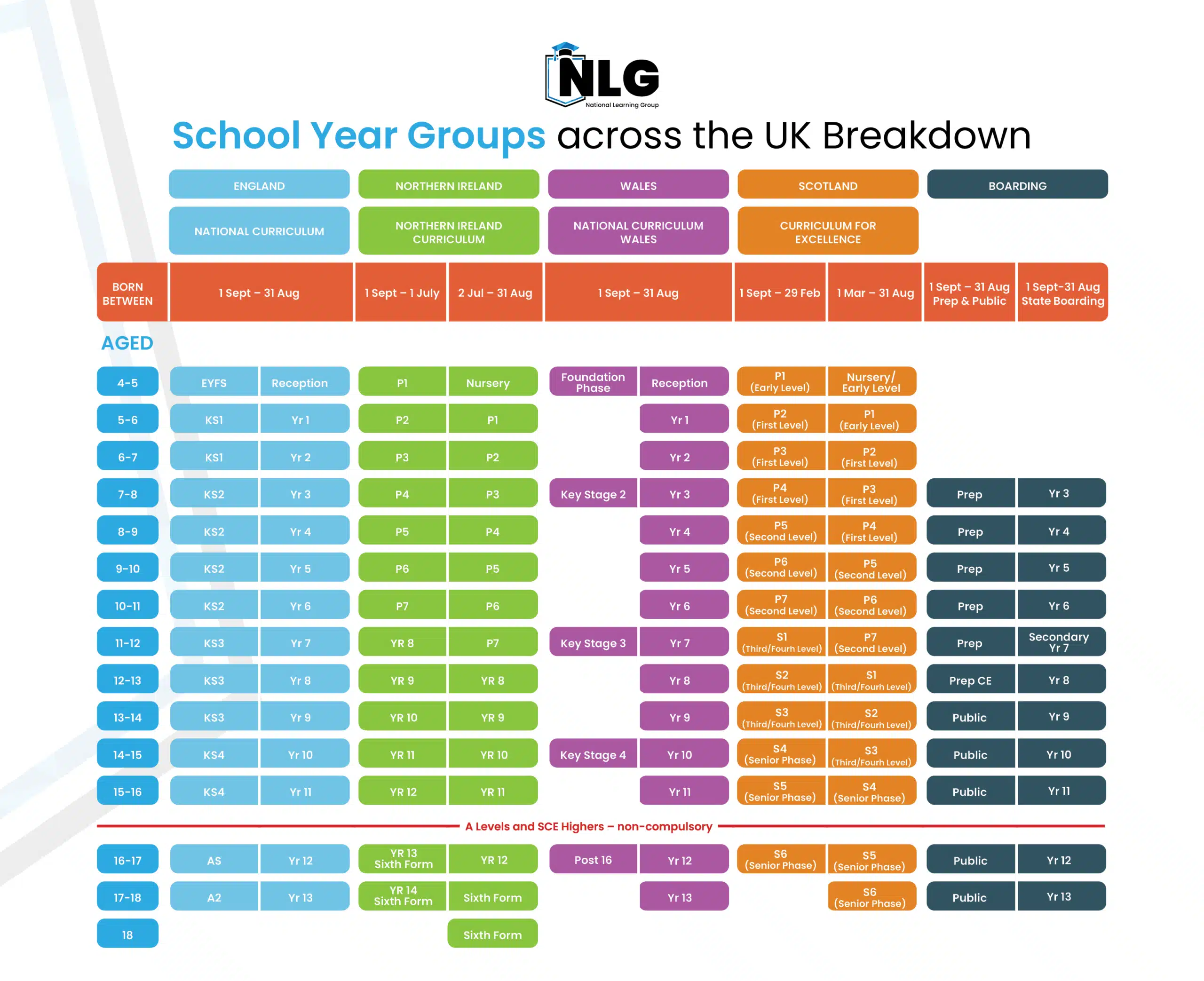
UK year groups and school stages in one place
This visual guide is useful when comparing a child’s age, year group and likely education stage.
Why this matters for tutoring
Tutoring should match the learner’s stage, not just their age. A Year 5 pupil preparing for SATs needs a different plan from a Year 7 pupil adjusting to secondary school or a Year 11 student preparing for GCSEs.
Find the Right TutorExplore tutoring by education stage
Once you know your child’s stage, the next step is choosing support that matches their year group, subject and confidence level.
National Curriculum key stages FAQs
What are National Curriculum key stages?
National Curriculum key stages are blocks of school years used to organise learning in England. They broadly group pupils by age, from Early Years through Key Stage 1, Key Stage 2, Key Stage 3 and Key Stage 4.
What years are Key Stage 1 and Key Stage 2?
Key Stage 1 covers Years 1 and 2, usually ages 5 to 7. Key Stage 2 covers Years 3 to 6, usually ages 7 to 11.
What years are Key Stage 3 and Key Stage 4?
Key Stage 3 covers Years 7 to 9, usually ages 11 to 14. Key Stage 4 covers Years 10 and 11, usually ages 14 to 16, when students usually work towards GCSEs.
Is Scotland the same as England and Wales?
No. Scotland uses a different structure, with Primary years and Secondary years such as S1 to S6. Broadly, S1 to S3 align with early secondary learning, while S4 to S6 are the Senior Phase.
Can tutoring support children at different key stages?
Yes. NLG offers online tutoring across education levels, including Early Years, Primary, Secondary, GCSE and A-Level support, with lessons matched to the learner’s age, subject needs and goals.
Need support at your child’s current key stage?
We will help match your child with a suitable DBS-checked tutor for their year group, subject and learning goals.